

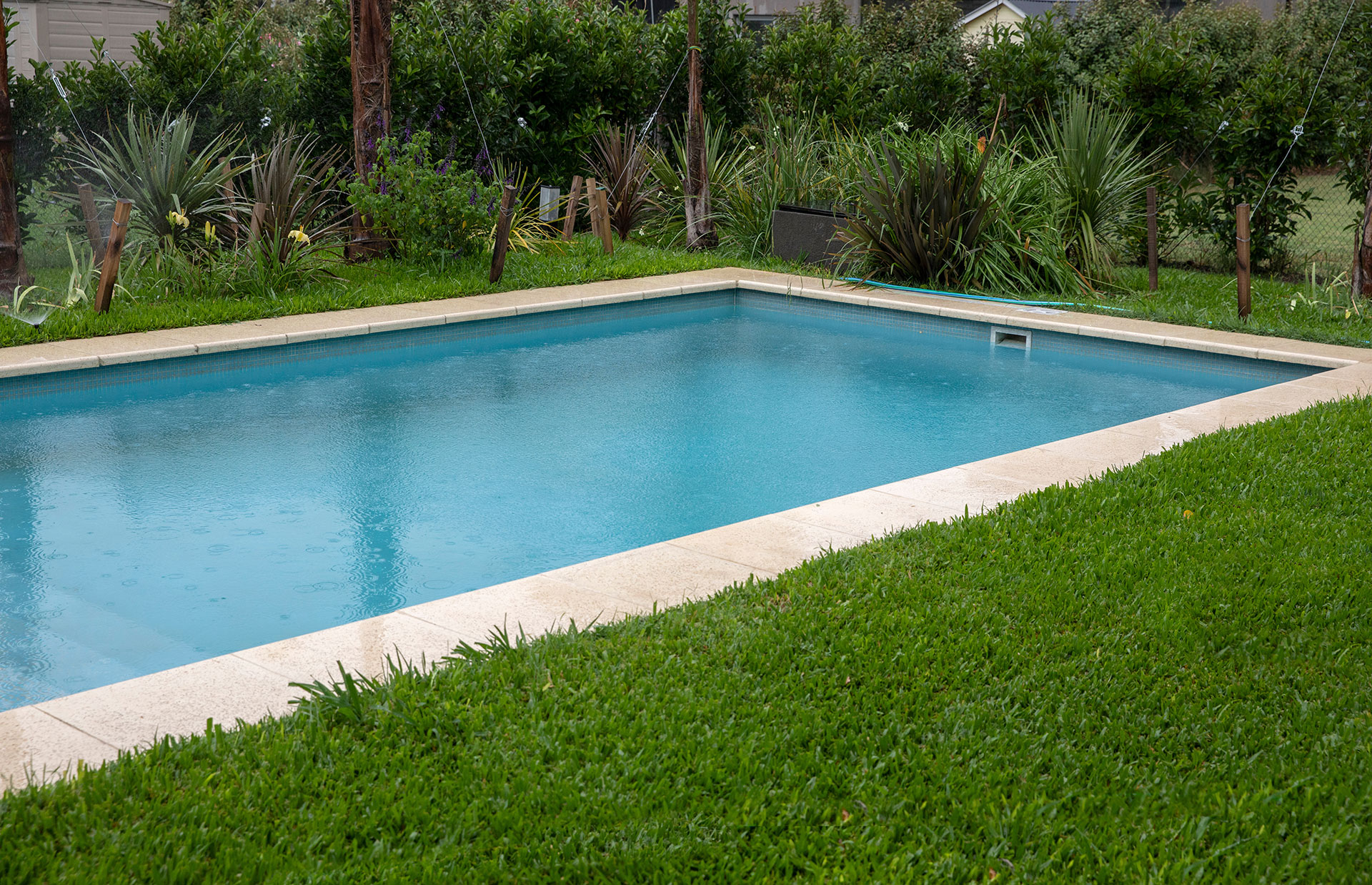
A big rainstorm can make a pool or hot tub look like it changed overnight—hazy water, dull color, maybe a little foam at the steps, and suddenly you’re wondering if something broke. Fortunately, most post-rain cloudiness is fixable without draining your pool or dumping in random chemicals.
Rain changes your water chemistry in a few predictable ways: it dilutes your balanced water, adds debris and organics, and can introduce contaminants from the surrounding yard (dust, pollen, fertilizer runoff). That combination often overwhelms sanitizer and clogs filtration—two of the fastest routes to cloudy water.
Let’s walk through what to test first (in the right order), what to adjust, and what habits to stop so you don’t accidentally make the problem worse.
Residential Swimming Pool Maintenance: What to Test First After a Storm
When the water turns cloudy, the temptation is to “treat the symptom” with clarifier, algaecide, or extra chlorine tablets. But in residential swimming pool maintenance, the fastest fix usually starts with testing a short list of water balances in the correct sequence—because one off-value can make everything else act weird.
Start here:
1) Free Chlorine (FC) and Combined Chlorine (CC)
This is your first checkpoint because sanitizer is what keeps the water clear in the first place.
- If FC is low: Rain and debris consume chlorine quickly. Low FC after a storm is extremely common.
- If CC is elevated: That means chlorine is busy fighting contaminants (chloramines), and you may need to “break through” with a stronger dose of liquid chlorine.
What to do: Bring FC up to your target range based on your stabilizer level (CYA). If you don’t know your CYA, test it (next step) before you keep adding chlorine.
2) Cyanuric Acid (CYA/Stabilizer)
CYA protects chlorine from sunlight, but it also determines how much chlorine you need for effective sanitation. Heavy rain can dilute CYA slightly, and splash-out/overflow can reduce it more.
What to do:
- If CYA is too low, chlorine burns off quickly and the pool struggles to stay clear.
- If CYA is too high, your chlorine becomes less effective and cloudiness can linger even when “chlorine looks fine” on basic strips.
3) pH and Total Alkalinity (TA)
Rainwater is typically on the acidic side, but what matters is how it interacts with your pool’s buffering system. After storms, pH often drifts, and TA can shift, both of which can reduce chlorine efficiency and increase the chance of cloudy water.
What to do:
- Aim for pH in the mid-7s (a comfortable, effective range).
- Keep TA steady so pH doesn’t bounce all week.
4) Calcium Hardness (CH) (Especially if You Have a Plaster Pool)
Cloudiness isn’t always “dirt;” it can be tiny particles from calcium imbalance. If your water is under-saturated or over-saturated, you can see haze.
What to do: Test CH and avoid big swings. If you suspect calcium clouding (a “milky” look), get the water balanced before throwing in extra products.
5) Filtration and Circulation Checks (Yes, This Counts as “Testing”)
Even perfect chemistry can look cloudy if the filter can’t keep up with storm debris.
Quick checks:
- Is your pump running long enough (or continuously for 24 hours post-storm)?
- Is the return flow weaker than usual?
- Is your pressure gauge 8-10 psi above clean baseline (a sign it’s time to backwash or clean)?
What to do: Run the pump longer, empty skimmer and pump baskets, and clean/backwash the filter as needed. A dirty filter is one of the most overlooked causes of post-rain cloudiness.
What to Stop Doing When Your Pool Turns Cloudy
Now for the habits that accidentally keep pools cloudy for days. If you stop these, your fix gets faster and cheaper.
Stop “Guess-Dosing” Chemicals
Adding a little of everything (tabs, shock, clarifier, algaecide) without confirmed test results often creates a tug-of-war in the water. You may temporarily mask the cloudiness, but it comes back or gets worse.
Better move: Test first, dose once, then retest.
Stop Relying On Strips Alone (for Storm Recovery)
Test strips are fine for quick checks, but post-rain troubleshooting is where accuracy matters. Strips commonly misread chlorine and can be unreliable for CYA: two of the biggest decision-makers.
Better move: Use a high-quality liquid test kit or bring a water sample to a professional for a full reading.
Stop Adding More Chlorine Tablets “Because Cloudy Means Low Chlorine”
Tablets add chlorine, yes, but they also add stabilizer (CYA). If your CYA is already high, tablets can push it higher and make chlorine less effective over time. That can turn a simple storm cleanup into a recurring haze problem.
Better move: Use liquid chlorine for quick control after storms, and reserve tablets for steady maintenance when your CYA is in range.
Stop Under-Running the Pump
Cloudiness is suspended material, so your filter can’t remove what it never circulates. After a storm, running your system “like normal” might not be enough.
Better move: Run the pump longer (often 12–24 hours post-storm), brush the walls/floor to lift debris into filtration, and clean the filter when pressure rises.
Stop Mixing Products Too Quickly
Clarifier and flocculant can help in specific situations, but they’re not first-line fixes, and combining products too soon can gum up filters or create more haze.
Better move: Balance chemistry + filtration first. If the pool is still cloudy after you’ve restored sanitizer and cleaned the filter, then consider targeted products (or call a pro to avoid expensive trial-and-error).
A Simple Post-Rain Recovery Routine That Works
If you want a clear “do this, then this” plan:
- Skim and empty baskets (remove what you can physically remove first)
- Brush walls and floor
- Test FC/CC, CYA, pH, TA (and CH if applicable)
- Correct sanitizer first, then balance pH/TA
- Run filtration longer and clean/backwash as needed
- Retest the next day and fine-tune
If the water is turning green, has a strong odor, or won’t clear after 48 hours of proper chlorine + filtration, you may be dealing with early algae, high CYA complications, or a filtration issue that needs hands-on diagnosis.
Need Helping Clearing It Fast? Call Ole’s Pool and Spa
If your pool is cloudy after a storm and you’d rather not play chemical roulette, Ole’s Pool and Spa can test your water, identify what’s actually causing the haze, and get your system back to clean, clear, comfortable water—without wasted products or repeat problems. Reach out today to schedule residential swimming pool maintenance and get your pool back in shape quickly.